Platforms

The operating system for GenAI-native software.

Juego builds and deploys software platforms that serve as the chassis for product engineering. JaiCode runs the gated agentic SDLC. Boutique and Box are how institutions get products on that chassis. FDEs put it in the field.

Stack

Three layers. One deployment model.

Operating system first. Product offerings on top. Forward Deployment Engineers put them in the field.

01 · Operating system

↳JaiCode

Local-first IDE · CLI · companion for Map → Operate.

Modes constrain tools; plans unlock side effects; Agent Review scores the diff. BYOK for Claude, OpenAI, Gemini, and private endpoints. Context packs and path grants keep GenAI inside safe bounds—especially in regulated domains.

  • Ask / Plan / Debug / Build modes with human gates
  • Multi-model BYOK under your procurement
  • Agents Window ceremonies and companion admin
  • Local-first execution against your checkout
02 · Product offering

↳AI Boutique Shop

Bespoke GenAI products, crafted end to end.

Greenfield and high-craft builds where FDEs and your owners share one JaiCode workspace—from brief through MLP with Plan unlock and Agent Review on every generative cut.

  • Discovery through release on the software_dev spine
  • Architecture, UX, and release crafts on the squad
  • Transfer of practice when the embed ends

03 · Product offering

↳AI in a Box

Packaged agentic delivery your team can run.

A packaged path to stand up gated GenAI delivery—modes, context packs, and review—so your engineers keep the cadence after FDEs step back.

  • Fixed-phase Align → Prove → Ship
  • Enablement and co-delivery built in
  • Provisioned seats under your org

JaiCode factory

Watch how product moves through Map → Operate.

Interactive capability line Forward Deployment Engineers run on the platform.

Delivery factory

How a product moves through an agentic AI line.

JaiCode is the operating system. Generative AI is the engine; context engineering and gates are the line. Intent enters on the left; FDEs advance work through Map → Operate with Claude, OpenAI, Gemini, and other BYOK models. Click any station for detail.

Overhead · Developer experience

In

Out

Intent moving ↓

Shipped software

Now on the line → Map: Understand what exists

Factory floor · Foundations

In the room

The surfaces FDEs and client leads actually open.

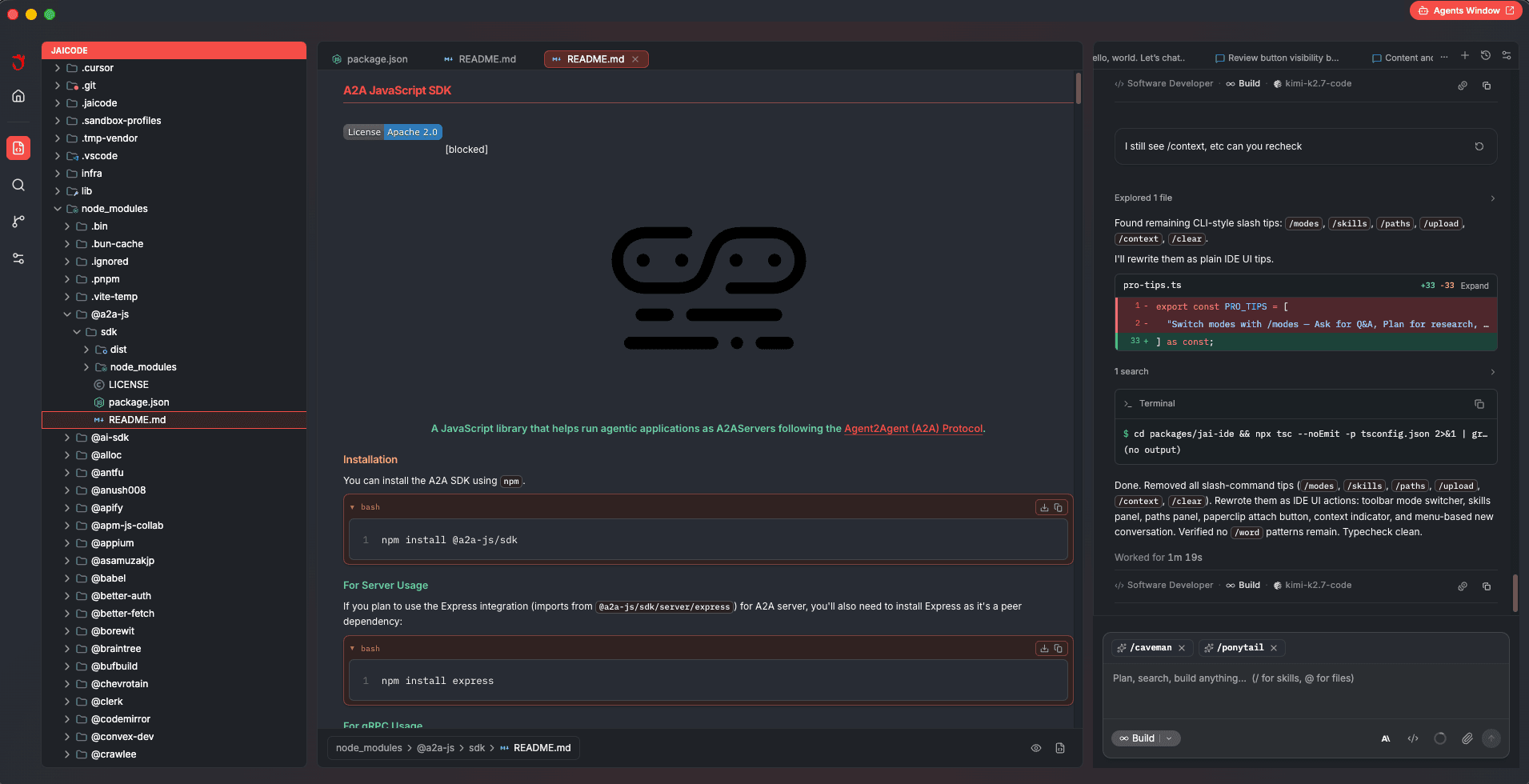
Screenshots from the JaiCode workspace—IDE, Agents Window, Agent Review, and source control.

  • Desktop IDE for Plan → Build against your checkout
  • Agents Window for ceremonies and parallel threads
  • Agent Review findings before anything merges

Desktop IDE

Desktop IDE with editor, chat, and workspace
powered by JaiCode

Gates

How generative work becomes shippable.

The platform does not let agents free-fire into main. Modes constrain tools; plans unlock side effects; Agent Review scores the diff.

Ask

Understand

Read-safe search, LSP, research, and exploration—no project writes. Where mapping and brownfield discovery start.

Plan

Decide

Research the repo, clarify scope, lock a structured plan. Humans approve before Build.

Debug

Diagnose

Evidence-first investigation, then targeted fixes when the diagnosis is solid.

Build

Execute

Edits, documents, shell, browser, MCP, and checkpoints when the plan is unlocked.

Agent Review runs against the diff—findings and a verdict before merge. FDEs and client leads disposition pass, fix, or escalate. No silent generative merges.

Trust

Why institutions let GenAI into their repos.

Local-first execution

Agents run on the machine against your checkout. Generative work stays inspectable—not trapped in a vendor sandbox you cannot audit.

Multi-model BYOK

Bring Anthropic Claude, OpenAI, Google Gemini, or other approved keys under your procurement. Usage stays attributable in the companion.

Context & path control

Path grants and run policy scope what agents may read and execute—especially critical in regulated domains.

Provisioned seats

Invite-only accounts, device approval, and admin. Your org owns seats; FDEs join as collaborators.

FAQ

Platform questions.